

Solar SG Announces Next Phase of Singapore’s Solar Energy Revolution
SINGAPORE, SINGAPORE, Aug. 24, 2026 (GLOBE NEWSWIRE) -- Solar SG Announces Next Phase of Growth as Singapore’s Solar Market Accelerates
Solar SG industry is entering a new phase of growth, with the Republic reaching 2 gigawatt-peak (GWp) of installed solar capacity — five years ahead of its original 2030 target.
The milestone has prompted the Government to raise its ambition, with Singapore now targeting 3 GWp of installed solar capacity by 2030, representing a 50 per cent increase over the previous target.
For the solar industry, the shift is significant. Solar is no longer viewed primarily as an environmental initiative. Falling equipment costs, improved panel efficiency and increasingly attractive payback periods are turning rooftop solar into a mainstream investment for homeowners, commercial property owners and businesses.
Government data shows that the number of private residential buildings with solar installations increased more than fourfold, from about 1,400 in 2020 to around 6,900 in 2025.
The economics are also changing rapidly. Rooftop solar systems can now have payback periods of around five years or even shorter, depending on the building and system.
From Niche Technology to Mainstream Investment
Singapore’s unique geography means solar plays a particularly important role in the country's energy transition.
With limited land for large-scale renewable energy projects, rooftop deployment allows Singapore to make use of an otherwise underutilised asset — the roofs of homes, factories, warehouses, commercial buildings and other developments.
“Every suitable rooftop represents an opportunity to generate clean electricity locally,” said Nicholas, Founder of Solar SG.“Singapore has moved beyond asking whether solar works. The question now is how quickly we can deploy it across the buildings that are suitable for solar.”
Solar SG Prepares for its Next Chapter
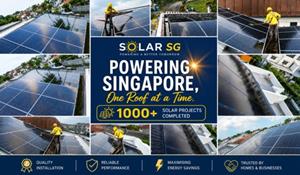
Solar SG, which says it has completed more than 1,000 solar projects, is positioning itself to capture the next phase of Singapore’s renewable-energy growth.
The company is also exploring an initial public offering (IPO) as part of its longer-term expansion strategy, with a potential listing intended to support the company’s growth, strengthen its capital base and provide resources for further expansion of its solar business.
The potential IPO comes as investor interest in renewable energy and distributed power infrastructure continues to grow globally.
For Solar SG, the focus is on building a scalable platform capable of serving Singapore’s residential, commercial and industrial markets while potentially expanding into regional opportunities.
“The solar industry is entering a very different phase,” said Nicholas.“We have proven that there is strong demand for solar in Singapore. The next step is to build a company and platform that can scale with that demand.”
Residential Adoption Still Has Considerable Room to Grow
Despite the rapid increase in installations, the residential market remains relatively underpenetrated.
As of the end of 2025, about 6,900 private residential buildings had registered solar installations for the export of excess electricity to the grid. Collectively, these systems represented 115.3 MWp, or about 5.5 per cent of Singapore’s total installed solar capacity.
This suggests considerable potential remains, particularly among landed homeowners with suitable roof space.
For homeowners, the proposition has also become more straightforward: generate electricity during daylight hours, reduce reliance on grid electricity and potentially export excess generation, while benefiting from a relatively short investment payback period.
A More Sophisticated Solar Customer
For Solar SG, the market shift is being reflected at the ground level.
Nicholas believes the next wave of adoption will increasingly be driven by consumers looking beyond simply installing solar panels.
“Customers are becoming much more sophisticated,” said Nicholas.“They are asking about panel efficiency, inverter technology, energy monitoring, battery storage, electric-vehicle charging and how the entire energy system can work together.”
That change is significant for the industry. Solar installations are increasingly being designed as integrated energy systems rather than standalone photovoltaic arrays.
The next 1 GWp
Singapore's achievement of 2 GWp is unlikely to represent the end of the country's solar story.
Instead, it marks the beginning of the next stage.
The Government's new 3 GWp target for 2030 means another 1 GWp of solar capacity must be deployed over the coming years.
For companies such as Solar SG, the opportunity will be to make solar adoption simpler, more transparent and more economically compelling for property owners.
“The next phase is not simply about putting more panels on roofs,” said Nicholas.“It is about making every suitable roof work harder — generating electricity, reducing operating costs and becoming part of a smarter energy ecosystem.”
Singapore's solar story has evolved considerably in just a few years. What was once a relatively niche technology is becoming an increasingly normal feature of the country's buildings.
With the 3 GWp target now in sight, Solar SG believes the sector is entering one of its most important periods of growth yet — and is positioning itself for a potential public-market future.
About Solar SG
Solar SG is a Singapore-based solar energy company providing rooftop solar solutions for residential, commercial, and industrial properties. The company says it has completed more than 1,000 solar projects and focuses on helping property owners adopt efficient, cost-effective renewable energy systems.
Website: https://solar-sg.com/
Attachment

Singapore Office
Solar SG
sales@solar-sg.com

Solar SG
Solar SG
Legal Disclaimer:
EIN Presswire provides this news content "as is" without warranty of any kind. We do not accept any responsibility or liability for the accuracy, content, images, videos, licenses, completeness, legality, or reliability of the information contained in this article. If you have any complaints or copyright issues related to this article, kindly contact the author above.
